· Guide · 3 min read
ISO 27001 Annex A Controls: How to Select, Implement and Evidence Them
Learn how to move from Annex A control lookup to justified applicability, practical implementation, operating evidence and Statement of Applicability maintenance.
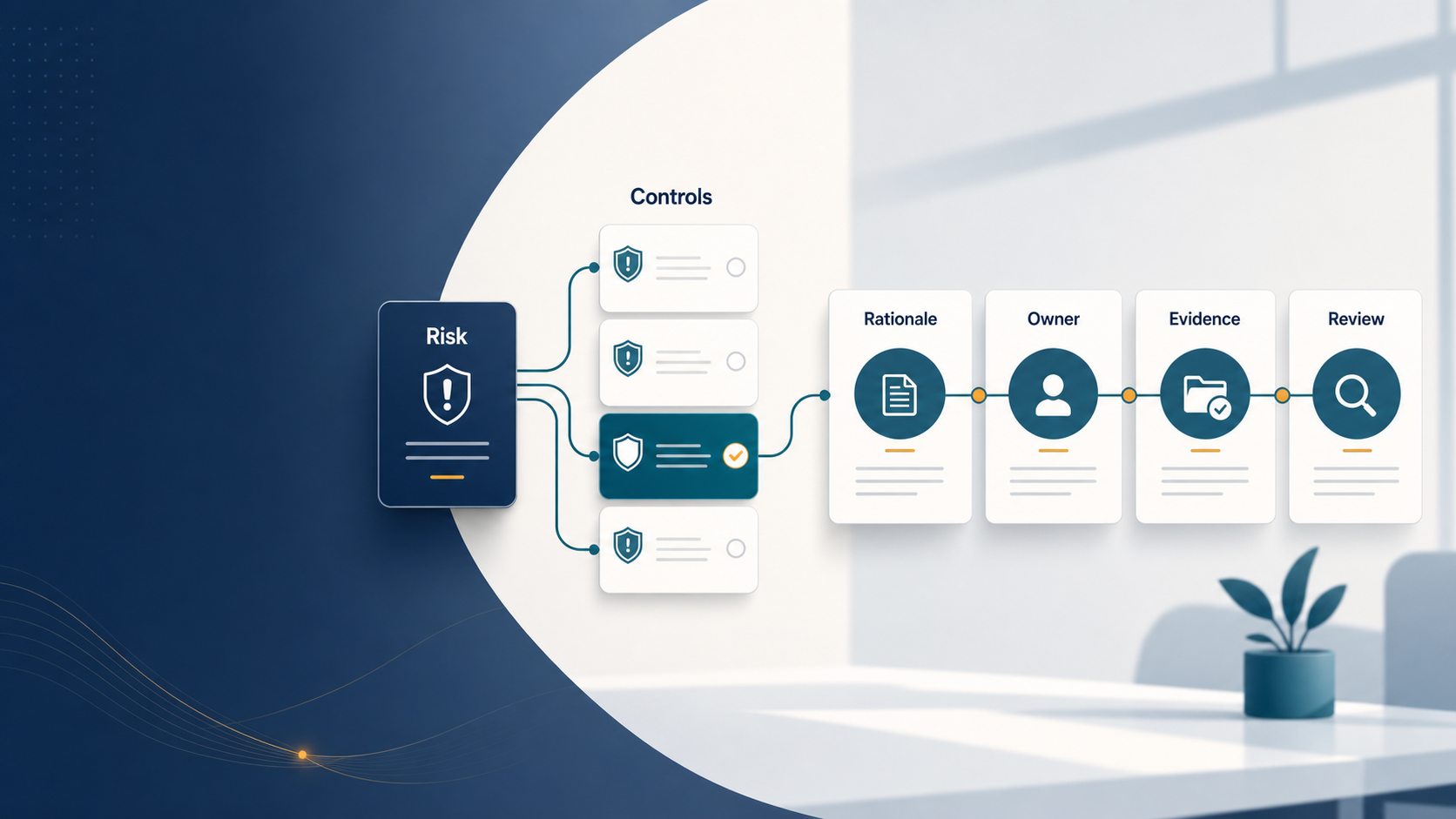
Annex A is often treated as a shopping list. That leads teams to select controls first and explain the risk later. A stronger workflow begins with the organization’s context, requirements and risk assessment. Controls are then considered as part of treatment and recorded in the Statement of Applicability. Use the free Annex A Control Lookup to navigate individual controls, then apply this decision process.
1. Start with the risk scenario
Write the risk in a way that can support a decision. Identify the affected service or information, the event, the weakness and the consequence. Example: Excessive privileged access allows an unauthorized production change, causing service disruption and loss of data integrity. Now the team can consider controls that prevent, detect, respond to or recover from the scenario.
2. Identify relevant obligations
Control needs may come from more than risk scoring. Consider contracts, customer commitments, laws, regulations, internal policy and other interested-party requirements. A control may be necessary even where the numerical risk score appears modest.
3. Decide applicability with a rationale
The Statement of Applicability should make control decisions traceable. For each control, record:
- whether it is applicable;
- why;
- implementation status;
- how it is implemented or referenced;
- owner; and
- relevant evidence. A rationale such as “not applicable because we are in the cloud” is usually too broad. Cloud services change responsibilities; they do not automatically eliminate them.
4. Translate the control into operating activities
A control label is not an implementation plan. For a review activity, define scope, frequency, reviewer, inputs, exceptions, approval and follow-up. For a technical control, define coverage, configuration, monitoring, exceptions, change management and testing. For a supplier control, define due diligence, contractual terms, ongoing review, incident coordination and exit considerations.
5. Identify design and operating evidence
Design or implementation evidence may include policy, procedure, architecture, configuration standard or responsibility matrix. Operating evidence may include completed reviews, alerts, tickets, tests, approvals, reports and corrected exceptions. Examples: Access control:
- design: policy, roles, access matrix;
- operation: requests, approvals, recertification, removal. Backup:
- design: policy, schedule, architecture;
- operation: job results, failed-job follow-up, restore tests. Monitoring:
- design: logging requirements, alert rules, escalation process;
- operation: alerts, investigations, decisions and closure.
6. Test effectiveness
Existence is not effectiveness. Ask whether the activity covers the intended population, happens at the required time, identifies relevant exceptions and produces follow-through. Sampling can reveal gaps that a policy review misses.
7. Maintain the decision
Review applicability when risk, scope, technology, suppliers, obligations or business processes change. Keep version history and approvals so changes are explainable. Explore controls: Annex A Control Lookup
Record applicability, justifications, implementation status and evidence references: ISO 27001 Statement of Applicability Builder
Check the surrounding requirements: ISO 27001 Clause Explainer Assess overall readiness: ISO 27001 Readiness Checker Source: Official ISO/IEC 27001 overview — ISO overview of ISO/IEC 27001:2022