· Checklist · 4 min read
ISO 27001 Readiness Assessment: A Practical Pre-Audit Checklist
Use this practical ISO 27001 readiness assessment to find gaps in scope, risk management, evidence, internal audit and management review before certification.
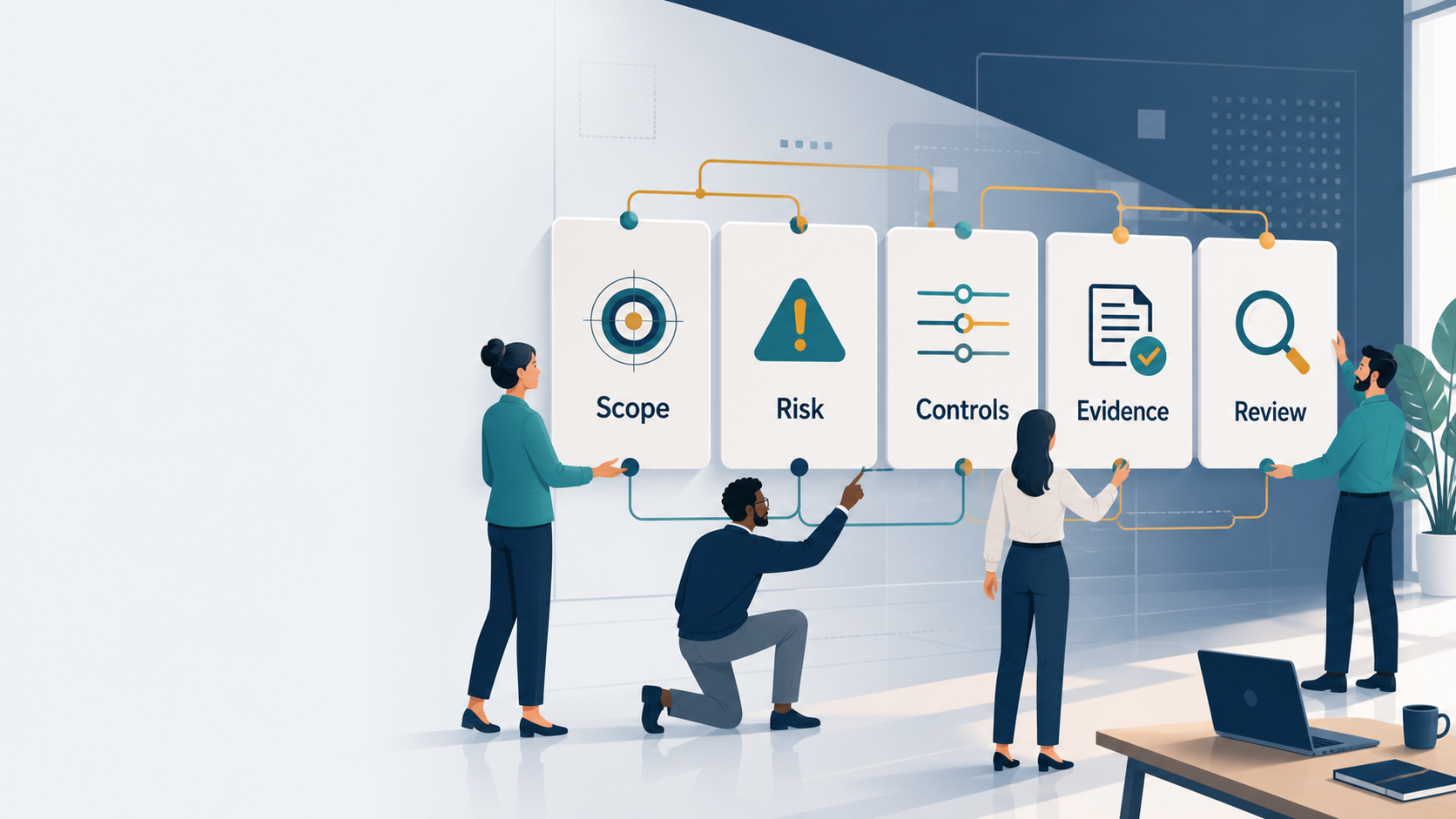
An ISO 27001 readiness assessment answers a simple question: if an auditor asked for evidence today, what could your team show? It is not a prediction of certification. It is a structured review of whether the core parts of your information security management system exist, operate and produce evidence. ISO describes ISO/IEC 27001:2022 as the requirements standard for an information security management system. It covers establishing, implementing, maintaining and continually improving an ISMS. That is why readiness cannot be reduced to a policy checklist. Use the free ISO 27001 Readiness Checker to establish a quick baseline before working through the deeper checks below.
1. Is the ISMS scope clear?
A useful scope identifies the organizational units, services, locations, systems and interfaces covered by the ISMS. Ambiguous scope creates downstream confusion: risks may be assessed against the wrong boundary, controls may have unclear ownership, and evidence may not match the certification scope. Ask:
- Can a new team member explain what is in and out of scope?
- Are key interfaces and dependencies understood?
- Does the scope match what customers expect to be protected?
- Are exclusions or boundaries defensible? Related guide: ISO 27001 scope statement guidance.
2. Have context and interested parties been considered?
The ISMS should reflect the organization, not a generic template. Consider contractual commitments, customer expectations, legal and regulatory obligations, suppliers, business objectives and internal constraints. A common weakness is listing interested parties without turning their needs into actionable requirements. The useful output is not a long stakeholder list. It is a clear connection between relevant expectations and the way the ISMS is designed.
3. Is the risk method repeatable?
A risk assessment method should define how risks are identified, analyzed, evaluated and accepted. If two assessors apply the same method to the same scenario, their conclusions should be reasonably consistent. Check whether likelihood and impact scales have concrete definitions, risk acceptance criteria are documented, treatment decisions have owners, and residual risk is visible. Use the practical guide on building an information security risk register to test how your likelihood and impact criteria behave.
4. Can control choices be traced to risk and requirements?
Controls should not be selected because a template says every organization uses them. The team should be able to explain why a control is necessary, how it is implemented, who owns it and what evidence demonstrates operation. Use the Annex A Control Lookup to explore the control set, then document applicability and implementation in your Statement of Applicability.
5. Does operating evidence exist?
Policies show intent. Completed records show operation. Examples include access reviews, restore tests, supplier assessments, incident records, change approvals, training completion, internal audit results and management review minutes. For each important process, identify both the design document and the latest operating record. Evidence should also have context: owner, period, scope, version, review status and the requirement it supports.
6. Have internal audit and management review happened?
A team can have good security controls and still be unready if the management-system cycle has not been completed. Internal audit should evaluate the ISMS against planned arrangements and applicable requirements. Management review should consider the performance and continuing suitability of the ISMS. Findings and decisions should lead to tracked actions. Do not schedule both activities at the last minute merely to create documents. Leave enough time to investigate findings, correct gaps and show follow-through.
7. Are corrective actions closed effectively?
A closed task is not automatically an effective corrective action. Record the issue, determine the cause where appropriate, define the correction and corrective action, assign ownership, verify completion and check effectiveness. Repeated findings often signal that the organization fixed the symptom but not the underlying process.
Turn the assessment into a plan
Classify every gap:
- Critical: blocks a core ISMS requirement or leaves no credible evidence.
- High: material weakness likely to attract audit attention.
- Medium: process exists but is inconsistent or poorly evidenced.
- Low: clarity, usability or housekeeping improvement. Then assign an owner, due date, required evidence and review decision. Re-run the readiness check after material work is complete.
Final takeaway
ISO 27001 readiness is not the number of documents in a folder. It is the degree to which the ISMS is scoped, risk-based, operated, reviewed and evidenced. Start with the free Readiness Checker, investigate weak areas with the Clause Explainer and Annex A Control Lookup, and use the Risk Score Calculator to improve consistency. Sources: ISO overview of ISO/IEC 27001:2022 — ISO overview of ISO/IEC 27001:2022 NIST SP 800-30 Rev. 1 risk assessment guidance — NIST SP 800-30 Rev. 1